SpringBoot日志体系
使用 Commons Logging 进行所有内部日志记录(日志接口),但将底层日志实现保持开放状态。 为 Java Util Logging、Log4j2 和 Logback 提供了默认配置
内部日志接口
SpringApplication使用的是org.apache.commons.logging.LogFactory
public class SpringApplication {
    private static final Log logger = LogFactory.getLog(SpringApplication.class);

    protected Log getApplicationLog() {
        if (this.mainApplicationClass == null) {
           return logger;
        }
        return LogFactory.getLog(this.mainApplicationClass);
    }
}
日志实现配置
LoggingApplicationListener监听AppicationEvent进行日志初始化
public class LoggingApplicationListener implements GenericApplicationListener {
    private void onApplicationStartingEvent(ApplicationStartingEvent event) {
        this.loggingSystem = LoggingSystem
              .get(event.getSpringApplication().getClassLoader());
        this.loggingSystem.beforeInitialize();
    }

    private void onApplicationEnvironmentPreparedEvent(
           ApplicationEnvironmentPreparedEvent event) {
        if (this.loggingSystem == null) {
           this.loggingSystem = LoggingSystem
                 .get(event.getSpringApplication().getClassLoader());
        }
        initialize(event.getEnvironment(), event.getSpringApplication().getClassLoader());
    }
}
LoggingSystem的静态Map常量SYSTEMS定义了使用日志的顺序logback > log4j2 > java logging
public abstract class LoggingSystem {
    private static final Map<String, String> SYSTEMS;

    static {
        Map<String, String> systems = new LinkedHashMap<>();
        systems.put("ch.qos.logback.core.Appender",
              "org.springframework.boot.logging.logback.LogbackLoggingSystem");
        systems.put("org.apache.logging.log4j.core.impl.Log4jContextFactory",
              "org.springframework.boot.logging.log4j2.Log4J2LoggingSystem");
        systems.put("java.util.logging.LogManager",
              "org.springframework.boot.logging.java.JavaLoggingSystem");
        SYSTEMS = Collections.unmodifiableMap(systems);
    }

    public static LoggingSystem get(ClassLoader classLoader) {
        String loggingSystem = System.getProperty(SYSTEM_PROPERTY);
        if (StringUtils.hasLength(loggingSystem)) {
           if (NONE.equals(loggingSystem)) {
              return new NoOpLoggingSystem();
           }
           return get(classLoader, loggingSystem);
        }
        return SYSTEMS.entrySet().stream()
              .filter((entry) -> ClassUtils.isPresent(entry.getKey(), classLoader))
              .map((entry) -> get(classLoader, entry.getValue())).findFirst()
              .orElseThrow(() -> new IllegalStateException(
                    "No suitable logging system located"));
    }
}
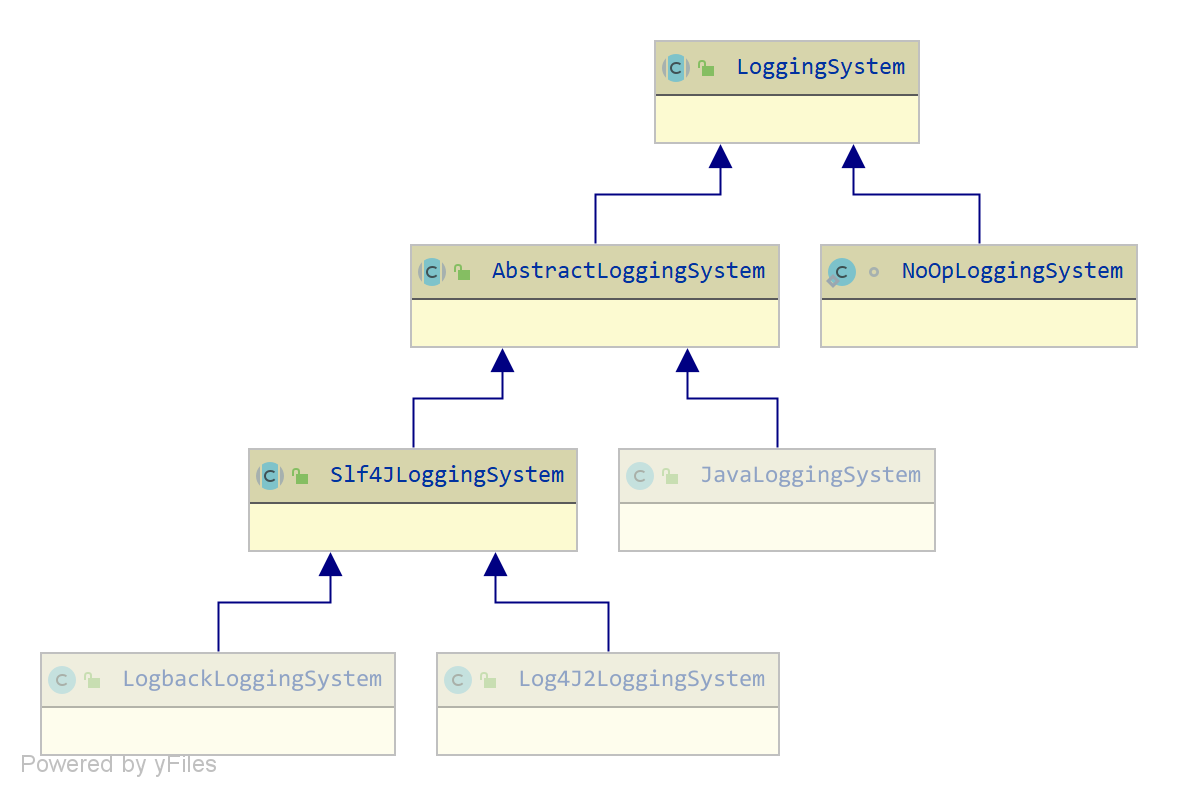
spring-boot-starters引入spring-boot-starter-logging,spring-boot-starter-logging引入了logback
<!-- spring-boot-starters -->
<dependency>
  <groupId>org.springframework.boot</groupId>
  <artifactId>spring-boot-starter-logging</artifactId>
  <version>2.1.0.RELEASE</version>
  <scope>compile</scope>
</dependency>

<!-- spring-boot-starter-logging -->
<dependency>
  <groupId>ch.qos.logback</groupId>
  <artifactId>logback-classic</artifactId>
  <version>1.2.3</version>
  <scope>compile</scope>
</dependency>
总结
- spring boot 按照logback > log4j2 > java logging的顺序查看是否引入对应的日志实现,决定使用哪个LoggingSystem。
- 使用spring-boot-starters的话会引入logback,默认就是logback
- 可以通过系统属性“org.springframework.boot.logging.LoggingSystem"使用自定义日志系统,或者不使用日志(设置值为none)